
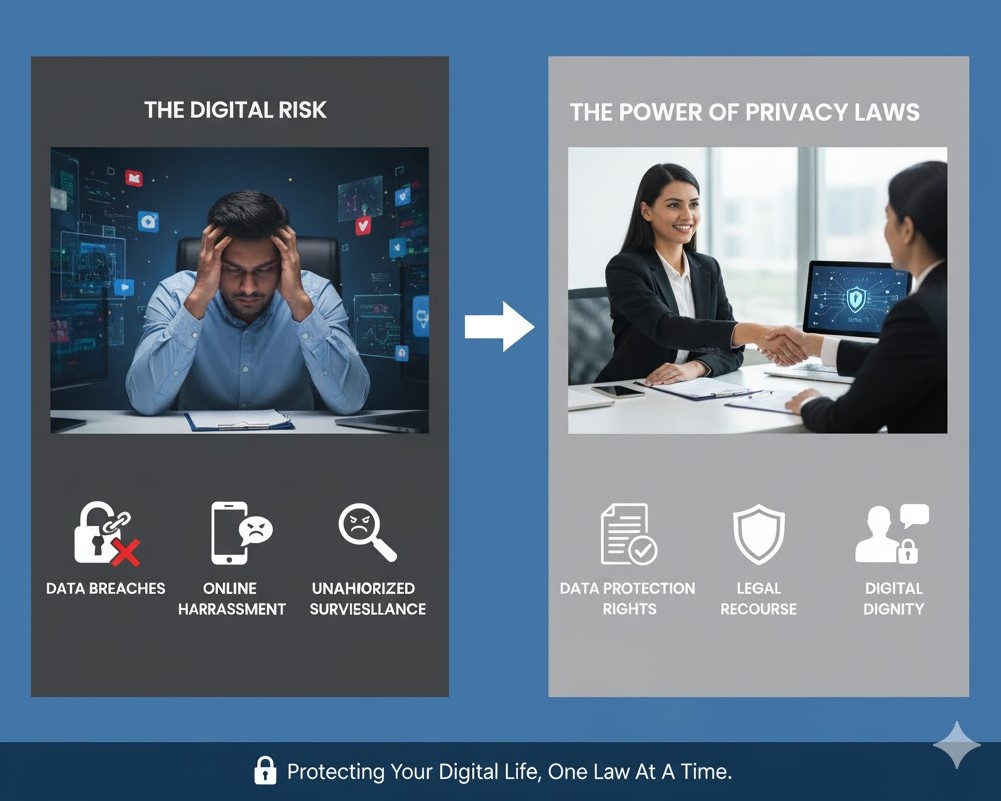
In the digital age, data is the world’s most valuable—and most vulnerable—commodity. Every click, transaction, and communication generates a data trail that, if misused or exposed, can lead to identity theft, financial fraud, and even manipulation. The growing urgency of privacy law reflects a fundamental shift: the law must catch up to the technology that now governs our lives.
At LexMatter, we recognize that expertise in cyber law and data protection is no longer a niche, but an essential component of modern law education.
1. The Erosion of Trust and the Need for Control
The central purpose of privacy law is to restore power and control to the individual (the “data principal”) over their personal information.
- Reclaiming Ownership: Laws like the EU’s General Data Protection Regulation (GDPR) and the new Digital Personal Data Protection (DPDP) Act in India establish that individuals have a fundamental right to their data. They grant rights such as the right to erasure (the “right to be forgotten”), the right of access, and the right to rectification.
- Mandating Consent: These laws move away from vague, buried terms and conditions toward a consent-based regime. Companies must now obtain free, specific, and unambiguous consent from users before processing their data, forcing transparency in data usage.
- Protecting Vulnerable Populations: Specific provisions, particularly concerning children’s data, require verifiable parental consent and prohibit targeted advertising, acknowledging the heightened vulnerability of minors in the digital space.
2. The Financial and Reputational Risk to Businesses
For companies, privacy law has become a critical matter of risk management, with the stakes measured in millions.
- Hefty Penalties: Regulations worldwide impose severe financial penalties for non-compliance. For instance, the GDPR can levy fines up to €20 million or 4% of a company’s total global annual revenue, whichever is higher. These fines are designed to be deterrents, making compliance an existential necessity, not an afterthought.
- Data Breach Obligations: Laws mandate that companies must implement reasonable security safeguards (like encryption and access controls) and, in the event of a breach, notify affected individuals and regulators without undue delay (often within 72 hours). Failure to handle a breach correctly compounds the legal and financial damage.
- Building a Competitive Edge: Companies that demonstrate a genuine commitment to customer privacy and security build stronger consumer trust and loyalty, turning compliance from a cost center into a competitive differentiator.
3. The Future of Law: Interoperability and Cyber Law
The global nature of the internet means a lawyer cannot simply understand one jurisdiction’s privacy law.
- Global Standards: Major statutes (like GDPR, CCPA in California, and DPDP) create a web of overlapping requirements. Lawyers must advise on cross-border data transfers and ensure client businesses can operate legally in multiple territories, requiring a global perspective in legal education.
- Defining Digital Rights: As technologies like AI and automated decision-making become prevalent, cyber law is defining the boundaries of ethical data use, especially when personal data is used for profiling or algorithmic decisions.
The importance of privacy law in today’s world cannot be overstated. It is the legal framework ensuring that our human rights and fundamental freedoms are protected in an era defined by ubiquitous digital data. Mastering this field is essential for any modern law career.
Ready to accelerate your expertise in privacy law and cyber law? Contact Us at LexMatter to explore our specialized law education programs.