
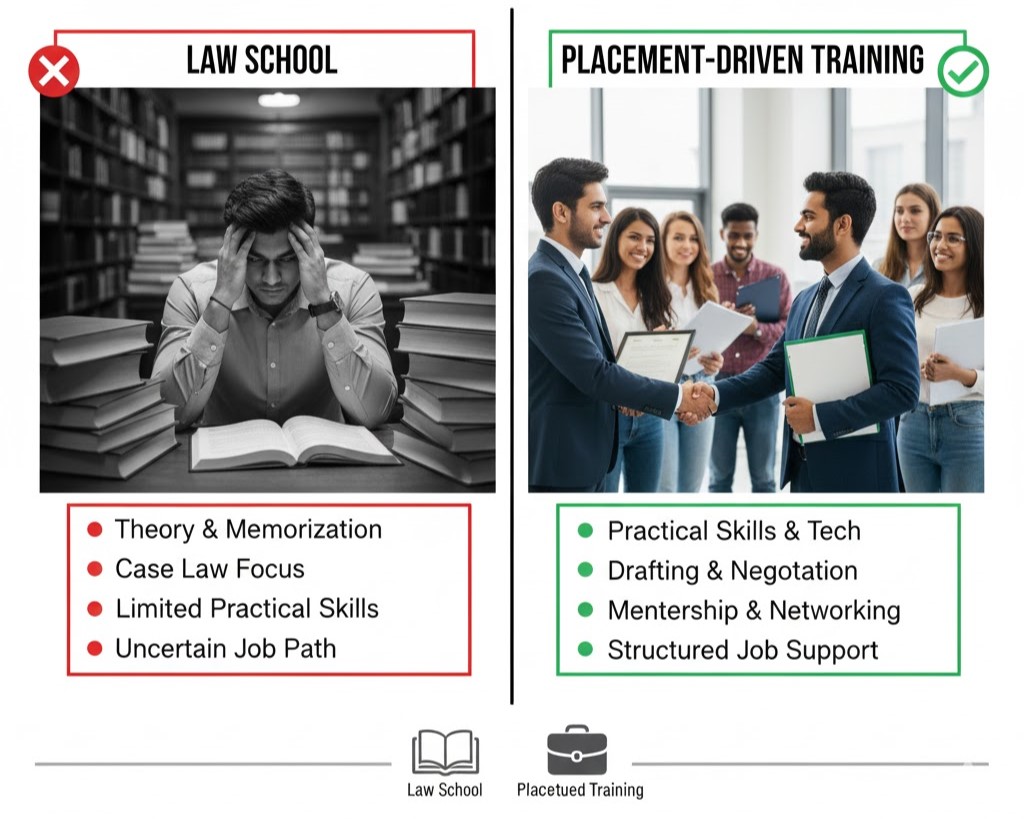
Choosing the path to a successful law career requires understanding the distinct roles of law education and targeted legal training. While law school provides the foundational knowledge and the requisite degree, placement-driven training provides the specialized, practical skills and direct pathways to job placement. They are not competitors, but sequential phases in professional development.
At LexMatter, we believe the optimal strategy involves leveraging the strengths of both, but recognizing where each provides the most value for your career goals.
Phase 1: The Law School Foundation (Why It’s Essential)
Law school is the non-negotiable step that grants you the academic credentials to practice law (where applicable) and the fundamental analytical skills.
- Core Legal Theory: Law school teaches you how to think like a lawyer—to analyze case law, interpret statutes, and apply complex legal theories. It covers the broad spectrum of jurisprudence, constitutional law, and legal history.
- The Credential: The degree (J.D., LL.B., etc.) is the license to operate. It is the necessary prerequisite for nearly all law jobs and for any subsequent specialized legal training.
- Academic Network: It provides the broad academic network of alumni, professors, and classmates that forms your initial professional circle.
The Drawback: Law school often lacks practical, market-driven job placement support and rarely focuses on the specific, operational skills demanded by modern firms (like advanced contract drafting or legal tech proficiency).
Phase 2: Placement-Driven Training (The Career Accelerator)
This specialized training begins where law school ends, focusing entirely on making you job-ready and securing employment.
| Feature | Law School (Broad Theory) | Placement-Driven Training (Niche Skill) |
| Goal | Legal literacy, philosophical understanding | Job placement, specialized skill mastery |
| Curriculum | Broad topics (Contracts, Torts, Property) | Niche, high-demand areas (Cyber Law, Financial Compliance) |
| Methodology | Lectures, case study analysis, exams | Mock interviews, practical drafting, simulation projects |
| Output | Academic degree/grades | Professional work portfolio, direct job placement support |
Why You Need Placement-Driven Training:
- Skills Gap Closure: It equips you with the immediately marketable skills that firms will pay for, bridging the gap between theory and law practice.
- Targeted Expertise: It allows you to specialize quickly in lucrative fields, making you stand out from the general pool of law graduates.
- Guaranteed Support: Programs like LexMatter offer dedicated job placement cells, mock interview preparation, and direct industry referrals, turning your educational investment into a high-probability career outcome.
The Optimal Choice: Combination and Sequence
The smartest choice is to complete the foundational law school requirement, and then immediately follow it with placement-driven training focused on a high-growth niche.
- Law School: Provides the “Why” and the “License.”
- Placement-Driven Training: Provides the “How” and the “Job.”
To succeed in your law career, you need both. But in today’s market, the specialized, job-oriented training is the difference between being eligible for a law job and securing one.
Ready to accelerate your law career with specialized legal training and dedicated job placement support? Contact Us at LexMatter to explore our career-focused programs.