
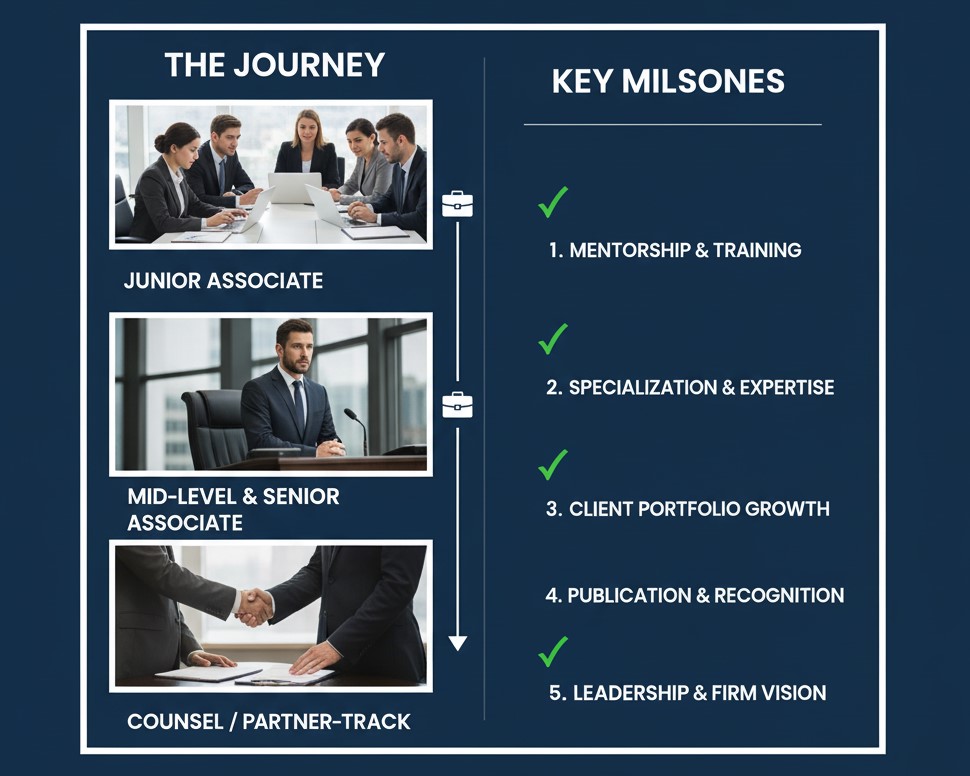
The journey from a junior associate to a law firm partner is often described as a marathon, not a sprint. It’s the ultimate goal for many in law career progression, signifying a shift from employee to co-owner. To make this ambition a reality, you need more than just legal skill—you need a strategic legal growth plan.
This roadmap outlines the typical stages and key milestones to guide your law practice journey to the pinnacle of partnership.
Stage 1: The Junior Associate (Years 1-3) 📚
This foundational phase is about mastering the basics of law practice, building your reputation, and becoming a reliable team player.
Key Focus Areas:
- Legal Mastery and Diligence: Consistently deliver exceptional performance on every task. This means impeccable legal research, error-free writing, and meticulous attention to detail. Your reputation starts here—a partner should be able to sign your work with confidence.
- Skill Development: Hone your core legal skills. This includes legal analysis, drafting, and understanding courtroom or transactional procedures. Seek out and act on feedback from supervising attorneys.
- Firm Citizenship: Be a team player. Volunteer for firm committees or internal projects. Build strong, professional relationships with partners, senior associates, and staff.
- Mentorship: Actively seek a mentor (or several) within the firm who can provide guidance, expose you to key clients, and advocate for you in partnership discussions.
Stage 2: The Mid-Level Associate (Years 4-6) 📈
The focus shifts from execution to ownership of work and increasing visibility. You’re beginning to manage aspects of cases and projects yourself.
Key Milestones:
- Practice Specialization: Define and deepen your expertise in a niche practice area. Become the “go-to” associate for a specific type of law or client issue.
- Client Relationship Building: Take a more active role in client interactions. You must transition your mindset to see the firm as a business and your work as a core part of client service. Start proactively cultivating your own professional network.
- Leadership Initiative: Begin supervising and mentoring junior associates and summer clerks. Demonstrate the ability to lead a team and manage complex projects without constant partner oversight.
- Internal Advocacy: Have a transparent discussion with partners about your desire for partnership and clearly understand your firm’s specific criteria, including billable hour expectations and business development metrics.
Stage 3: Senior Associate / Counsel (Years 7+) 💼
This is the critical “prove it” phase, where your performance must demonstrate that you are already operating as a partner-in-training. The average timeline for partnership consideration is 7 to 10 years, though this varies widely between firms and practice areas.
The Partnership Imperative: Business Acumen
At this stage, your legal skills are assumed. The focus is almost entirely on your ability to generate revenue and strategically contribute to the firm’s future.
- Develop a Book of Business: This is arguably the most crucial factor. You must demonstrate a proven ability to acquire and retain clients (a “portable book of business”) or the clear potential to do so in the near future. Start publishing articles, speaking at industry events, and leveraging your professional network to build your personal brand.
- Client Management and Retention: Exhibit mastery in managing complex client relationships and ensuring client satisfaction. This shows you can handle the client-facing responsibilities of a partner.
- Firm Strategy and Leadership: Contribute to the strategic direction of your practice group or the firm as a whole. Take a prominent role on firm committees or lead major internal initiatives.
- Preparing a Business Plan: For partnership consideration, you will likely need a formal business plan detailing your strategy for client growth and how you will contribute to the firm’s profitability.
Partner Status: Equity vs. Non-Equity
When you reach the final stage, it’s vital to understand the difference in partnership types:
| Partnership Type | Description | Key Feature |
| Non-Equity Partner | A salaried position with a higher title and more responsibilities, but generally without an ownership stake or profit sharing. Often a stepping stone to Equity. | Higher salary, more responsibility, no ownership. |
| Equity Partner | True co-owner of the firm. You invest capital (a “buy-in”) and share in the firm’s profits and losses. You have a direct vote in firm governance. | Ownership, profit share, greater firm influence. |
Your goal should be clear: you must convince the existing partners that admitting you will increase the firm’s revenue and prestige. Partnership is not a reward for past work; it’s an investment in your potential future contribution.
The path to partner is rigorous, demanding a blend of legal excellence, political savvy, and genuine business acumen. For deeper insights on navigating the nuances of law career progression and connecting with industry leaders, visit the LexMatter community.
Interested in accelerating your legal growth? Contact Us today to discuss your career strategy.