
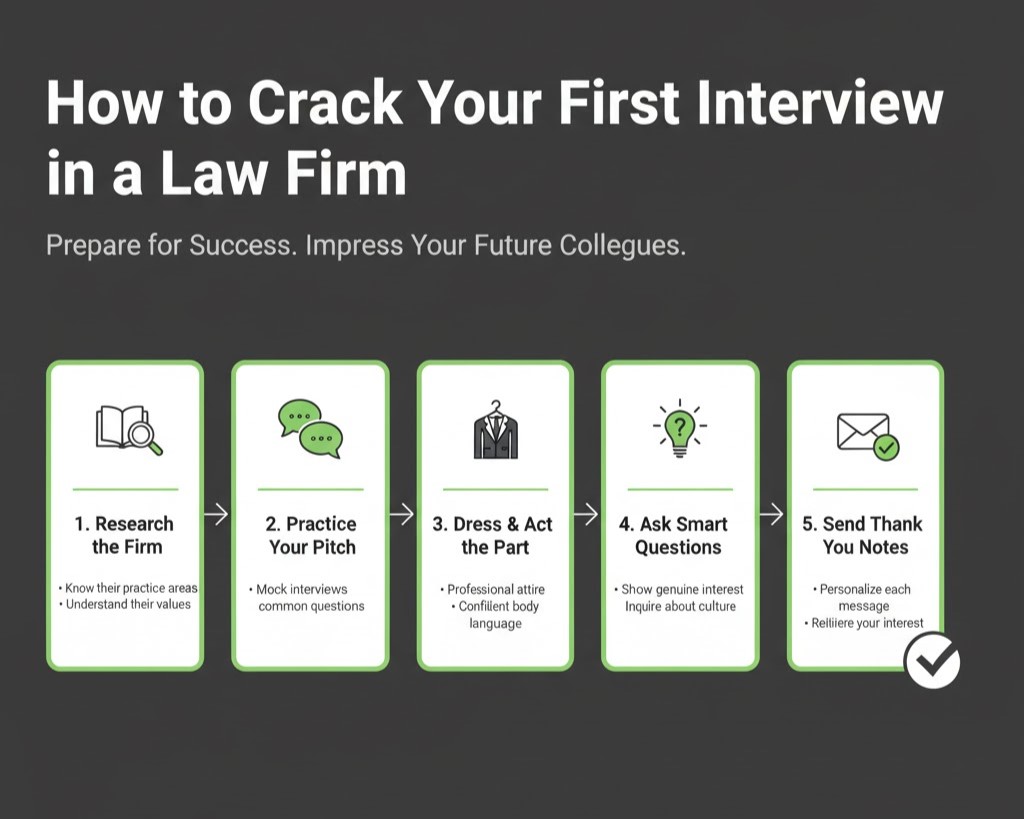
Your first interview for a law job is often the biggest hurdle in your law career. It’s the moment you must transition from being a successful student to a valuable professional. Law firms, especially the top-tier ones, aren’t just looking for high grades; they are looking for competence, character, and commitment.
At LexMatter, we understand that legal interviews are a specialized skill set. Our job placement strategies focus on preparing you to answer not just what you know, but how you think and how you behave under pressure.
Phase 1: Preparation is Not Optional—It’s the Law
The key to confidence is preparation. You must know the firm and know yourself better than anyone else.
1. Research the Firm’s Soul, Not Just Its Website
Go beyond the firm’s ‘About Us’ page.
- Practice Groups: Know the specific practice area (e.g., M&A, Litigation, Cyber Law) you are interviewing for and cite recent deals, cases, or press releases related to that group.
- The Interviewer: Look up the interviewer’s background on LinkedIn and the firm’s site. Find common ground (e.g., same alma mater, published article on a topic you studied) to build rapport.
- “Why This Firm?”: Prepare a concise, specific answer that articulates how the firm’s culture, recent achievements, or client base aligns perfectly with your goals for your law career.
2. Master Your Resume and Core Questions
Your resume is your script. Be ready to discuss every single internship, moot court, and project in detail.
- Behavioral Questions (STAR Method): Law firms rely heavily on competency questions to predict future behavior. Structure your answers using the STAR method:
- Situation: Describe the context.
- Task: Explain the goal you had to achieve.
- Action: Detail the specific steps you took (use “I,” not “we”).
- Result: Quantify the outcome (e.g., “reduced review time by 20%,” “won the motion”).
- Know Your Weakness: Choose a genuine, non-critical weakness (e.g., “I sometimes over-focus on details”) and pivot it into a strength by explaining the specific steps you take to manage it (e.g., “I now delegate initial document review to focus on the strategic overview”).
Phase 2: The Three Types of Interview Questions
Legal interviews typically cycle through three distinct types of questions. Be ready to transition seamlessly between them.
1. Motivational Questions
(They assess your commitment and fit)
- Examples: “Why law?” “Where do you see yourself in five years?” “What attracted you to our specific practice group?”
- Goal: Demonstrate a clear, consistent narrative from your past experiences to your desire to work at their firm.
2. Competency Questions
(They assess your practical skills)
- Examples: “Describe a time you worked under pressure/had to negotiate/faced a conflict.”
- Goal: Use the STAR method to demonstrate your soft skills: leadership, teamwork, communication, attention to detail, and resilience.
3. Commercial/Legal Awareness Questions
(They assess your market intelligence and legal thinking)
- Examples: “Talk us through a current issue affecting law firms/the industry.” “What is the biggest legal risk facing the Fintech sector today?”
- Goal: Show you think commercially. Don’t just state the facts; explain the impact on their clients and the solution the firm could offer. For a legal scenario, show your thought process (issue, rule, analysis, conclusion), not just the answer.
Phase 3: The Close – Your Final Impression
The end of the interview is your final chance to make a lasting impression.
1. Prepare Smart Questions for the Interviewer
This shows genuine curiosity and engagement. Avoid questions about salary, vacation, or anything easily found on their website.
- Good Questions: “What does the firm see as its biggest growth area in the next two years?” “What kind of legal training and mentorship can I expect in the first six months?” “What is the most challenging aspect of your practice group right now?”
2. Maintain Professionalism
- Body Language: Maintain eye contact, offer a firm handshake (if in-person), and sit up straight. Project confidence without arrogance.
- Follow-Up: Send a brief, personalized thank-you email to each interviewer within 24 hours, reiterating your interest and referencing a specific point you discussed.
A successful first legal interview is the result of focused preparation. By mastering the core questions, researching the firm deeply, and practicing the STAR method, you transform anxiety into assurance, securing your place in the competitive world of law jobs.
Ready to master the strategies for legal interviews and secure your first law job? Contact Us at LexMatter to explore our specialized interview and job placement training programs.