
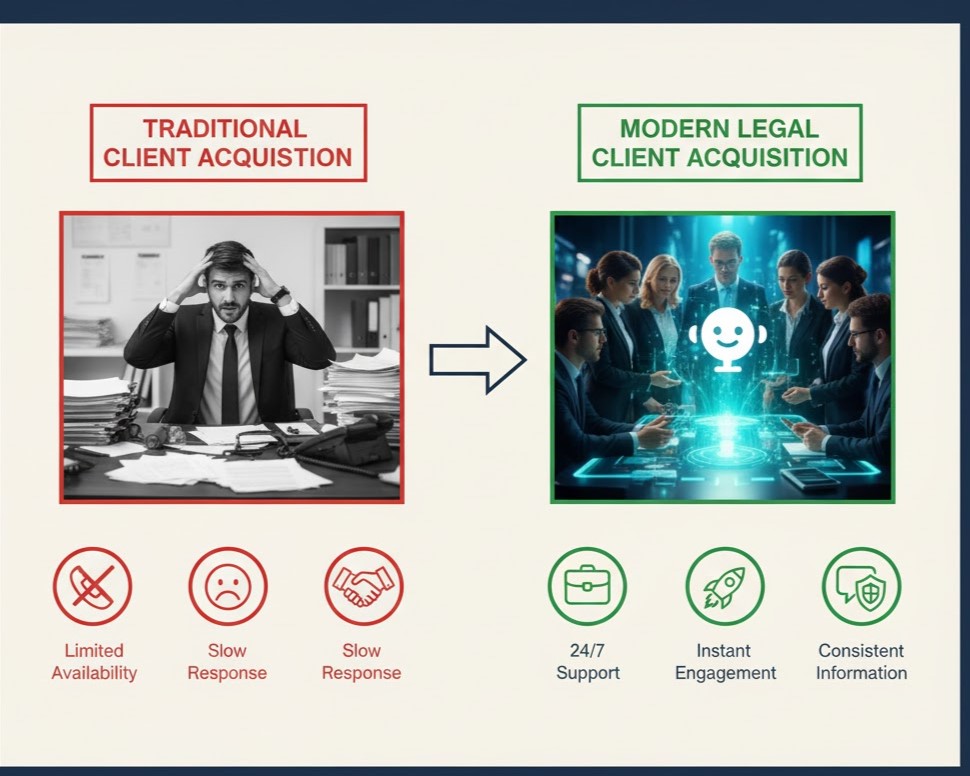
In today’s digital economy, potential clients expect instantaneous service. If a law firm’s website visitor has a question at 11 PM, and they have to wait until the next morning for an answer, they’ll likely move on to a competitor. This urgency is precisely why AI chatbots have become a transformative force in client acquisition for modern legal practice.
At LexMatter, we see AI chatbots as the essential frontline tool, ensuring that no lead is lost due to a lack of responsiveness, thereby creating a competitive advantage powered by legal tech.
1. Instant Engagement: The 24/7 Receptionist
The core value of an AI chatbot is its ability to provide immediate, around-the-clock availability, fundamentally changing the client’s first interaction.
- Real-Time Responsiveness: Chatbots instantly greet website visitors, ask initial qualifying questions, and prevent high-intent leads from abandoning the site. This meets the consumer expectation for immediate engagement, which significantly boosts conversion rates from visitors to qualified leads.
- Convenience for Clients: Since legal issues don’t adhere to business hours, the 24/7 nature of chatbots ensures that potential clients can get basic information and start their intake process whenever it is convenient for them.
- Cost Efficiency: For smaller firms and solo practitioners, a chatbot acts as a virtual assistant, handling routine inquiries and freeing up lawyers and administrative staff to focus on high-value, billable work, reducing the overall cost of client acquisition.
2. Streamlining the Intake and Qualification Process
A chatbot is far more than a simple FAQ tool; it is a highly efficient lead qualification and data collection engine.
- Intelligent Lead Qualification: Chatbots can be programmed to ask specific, practice-area-relevant questions (e.g., “In what county did the accident occur?” for a personal injury firm) to determine if a potential client has an actionable claim and is the right fit for the firm. This speeds up the intake process and reduces the time wasted on dead-end cases.
- Automated Data Collection: The bot collects critical preliminary information—contact details, brief case summaries, key dates—and often syncs it directly into the firm’s Customer Relationship Management (CRM) system. This ensures that when the human lawyer eventually takes over, they are fully prepared and the client doesn’t have to repeat themselves.
- Appointment Scheduling: The most effective bots integrate directly with the firm’s calendar, allowing qualified leads to book a consultation immediately, eliminating the frustrating email or phone tag delay.
3. Ethical and Strategic Considerations for Implementation
While powerful, law firms must implement AI chatbots carefully to protect client confidentiality and maintain ethical standards.
- No Legal Advice: Firms must program the chatbot to include clear disclaimers stating that the information provided is for informational purposes only and does not constitute legal advice or create an attorney-client relationship.
- Security and Privacy: Since the chatbot handles sensitive preliminary information, the platform must use strong security protocols, including encryption and multi-factor authentication, to comply with cybersecurity law and maintain client trust.
- Seamless Human Handoff: The chatbot must be able to gracefully escalate the conversation to a human lawyer or paralegal when the query becomes too complex, sensitive, or emotional. The goal is to augment, not abandon, the human connection.
By leveraging AI chatbots, firms transform their website from a static brochure into a dynamic client acquisition machine, ensuring a responsive, efficient, and professional first impression every time.
Ready to learn how to integrate AI chatbots ethically and effectively into your legal practice? Contact Us at LexMatter to explore our specialized legal tech training programs.